Green-Eyed Body Possession
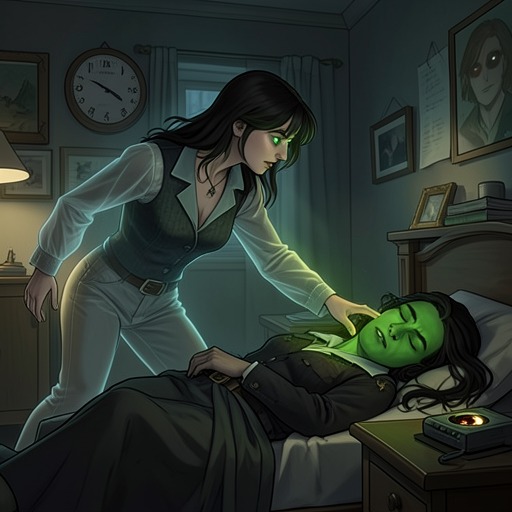
Living with 7 vampiresGreen-Eyed Body Possession is the mechanism through which beings from an adjacent other world cross into the ordinary world by taking over bodies. The process makes the body both a refuge and a disguise: the possessed may still look like a trusted vampire, yet green-glowing eyes, altered behavior, coercive speech, and sudden physical collapse reveal that another presence is acting through it. Because the invaders cannot ordinarily pass through the gate between worlds, possession becomes their practical means of entry and their chief threat to the people around Y/N.
Definition and Conditions
J-Hope explains that the other world lies near the ordinary one and contains beings similar to the vampires. According to his account, those beings cannot pass through the gate for some reason, but they can sometimes take over the vampires’ bodies when the vampires sleep. His explanation links possession to both spatial confinement and bodily vulnerability: the barrier between worlds remains in place, while sleep supplies the moment when control can be transferred. Y/N recognizes the beings as resembling vampires and asks whether J-Hope means vampires; J-Hope confirms that interpretation, establishing that the invaders imitate or inhabit the same kind of bodies rather than appearing only as remote spirits.
The process is not limited to a silent change within the host. When RM appears to be sleeping, he suddenly rises and looks at Y/N with green, glowing eyes. The altered RM invites her to come closer, repeats the command when she does not move, and then tries to break through the bars while shouting for her to approach. The scene turns a familiar person into an immediate physical danger: the body retains RM’s recognizable form, but the green eyes and aggressive command mark the presence controlling it.
Manifestations and Possession Sequence
The recurring visual sign is the green eye. In one confrontation, the lights suddenly come on and expose a person who is nothing more than a shadow with green eyes. The shadow screams and runs away, showing that the possessing presence can also appear outside a stable human form. In another encounter, Y/N meets a pair of glowing green eyes in silence; immediately afterward, she experiences the sensation that her life has left her body. The sequence presents possession as an assault on bodily autonomy before it becomes an ordinary struggle for control. The invader’s gaze is not merely identifying evidence but part of the threat itself.
The clearest large-scale possession occurs when shadows move through a hall and disappear because of the light. Afterward, three bodies begin to move, rise, and open their eyes, all of them green. The sequence separates the bodies from the entities that animate them: the shadows withdraw or relocate, while the vacant or vulnerable bodies become active vessels. Possession therefore operates collectively as well as individually, creating the possibility that several familiar figures can be controlled at once and that the danger can spread through a group without immediately changing outward appearance.
Jungkook’s body provides a more explicit example of the host’s temporary status. With green eyes, Jungkook says that the expected person is not there and smirks at Y/N. When V calls for Y/N from a distance, the possessing presence says it will let her think about the situation, after which Jungkook’s body falls to the ground. Y/N infers that the entity has probably left his body. The collapse confirms that the host does not simply become permanently transformed; once the invader departs, the body may be left inert, while the entity remains capable of choosing when to enter and leave.
Effects on Bodies and Relationships
Possession intensifies the danger already present in the vampires’ relationship with Y/N. Before the broader explanation of the other world, Y/N experiences bodily violation from a vampire she believes she can trust: she feels lips on her collarbone, then a sharp pain, and discovers that he is drinking her blood while covering her mouth. Although this incident is not itself identified as body possession, it establishes the story’s larger pattern of bodies being treated as accessible resources and of trust being destabilized through physical control. The possessing entities extend that pattern from blood to identity, using another person’s body as an instrument against those who recognize and care for the host.
V’s reassurance offers a direct contrast to the invaders’ coercion. He tells Y/N that she is safe as long as she remains with the group, strokes her head, and kisses her forehead before her vision goes black. His protective gesture belongs to the same world of bodily contact in which possession, feeding, and forced movement occur, but it attempts to make physical proximity protective rather than predatory. The contrast remains unstable because Y/N cannot assume that a familiar body or a gentle gesture guarantees safety; possession makes recognition itself a problem.
The threat also produces a regime of suspicion around ordinary physical evidence. After Y/N is examined, a question is raised about the various holes found on her body. Jin claims that the injuries came from the group’s cat, and Suga immediately supports the explanation. This improvised concealment shows how supernatural bodies must be managed before human authorities or ordinary observers can interpret them. The body becomes evidence of hidden violence, while the vampires respond by inventing a harmless account rather than exposing feeding, confinement, or the dangers surrounding Y/N.
Recovery, Exposure, and Limits
Possession can be distinguished from the host’s ordinary condition, but the distinction is fragile. When Jin later stands frozen, Y/N approaches him and sees that his face and eyes are normal. He begins to shake and looks at his hands, which are covered in blood. The restored appearance does not erase the consequences of what happened: normal eyes indicate that the possession or altered state has passed, while the blood on Jin’s hands preserves the physical record of the episode. Recovery therefore restores recognizable identity without restoring innocence or removing responsibility from the scene.
The narrative repeatedly makes bodily truth more reliable than explanation. Green eyes appear before the invader is named; bodies rise after shadows vanish; a host collapses when the entity leaves; blood, wounds, and fear remain after control has changed hands. Even a heavy metal chain around a transformed figure’s neck functions as a visible sign that bodies can be sealed, altered, or controlled through material means. These details prevent possession from remaining an abstract supernatural rule. It is experienced through sight, pain, paralysis, movement, collapse, and the difficulty of knowing whose intention a body expresses.
Narrative Significance
Green-Eyed Body Possession converts the familiar vampire body into contested territory. J-Hope’s explanation supplies the cosmology, but the later scenes make the idea politically and emotionally concrete: an external group barred from the ordinary world enters by suspending the host’s agency, and those left outside must treat sleep, eyes, speech, and movement as possible signs of invasion. The result is a recurring crisis of recognition in which trust cannot rest on appearance alone.
The concept also links the story’s supernatural conflict to a broader struggle over who may control a life. Y/N is abandoned, attacked, pulled into a mirror, examined for unexplained wounds, and later witnesses the aftermath of violence; the vampires themselves can be used as vessels by entities that do not belong in their world. Possession thus belongs to the same narrative system as blood-drinking, imprisonment, transformation, and forced memory change. Each process makes the body manageable by someone else, while resistance depends on recovering the ability to identify, move, speak, or choose.
Its deepest consequence is epistemic as well as physical. A trusted face may conceal a green-eyed intruder, a shadow may be the visible form of a bodiless agent, and a collapsed body may signal that the invader has departed rather than that the person has died. By repeatedly separating outward form from inward agency, the story makes possession a central grammar of uncertainty: the danger is not only that the body will be harmed, but that the meaning of the body will no longer be clear.